About 4 to 4½ hours
Getting there
Paved road from Arusha to Karatu, then about 50 km of dirt road to Mang'ola: an hour or two from Karatu and the Ngorongoro area.
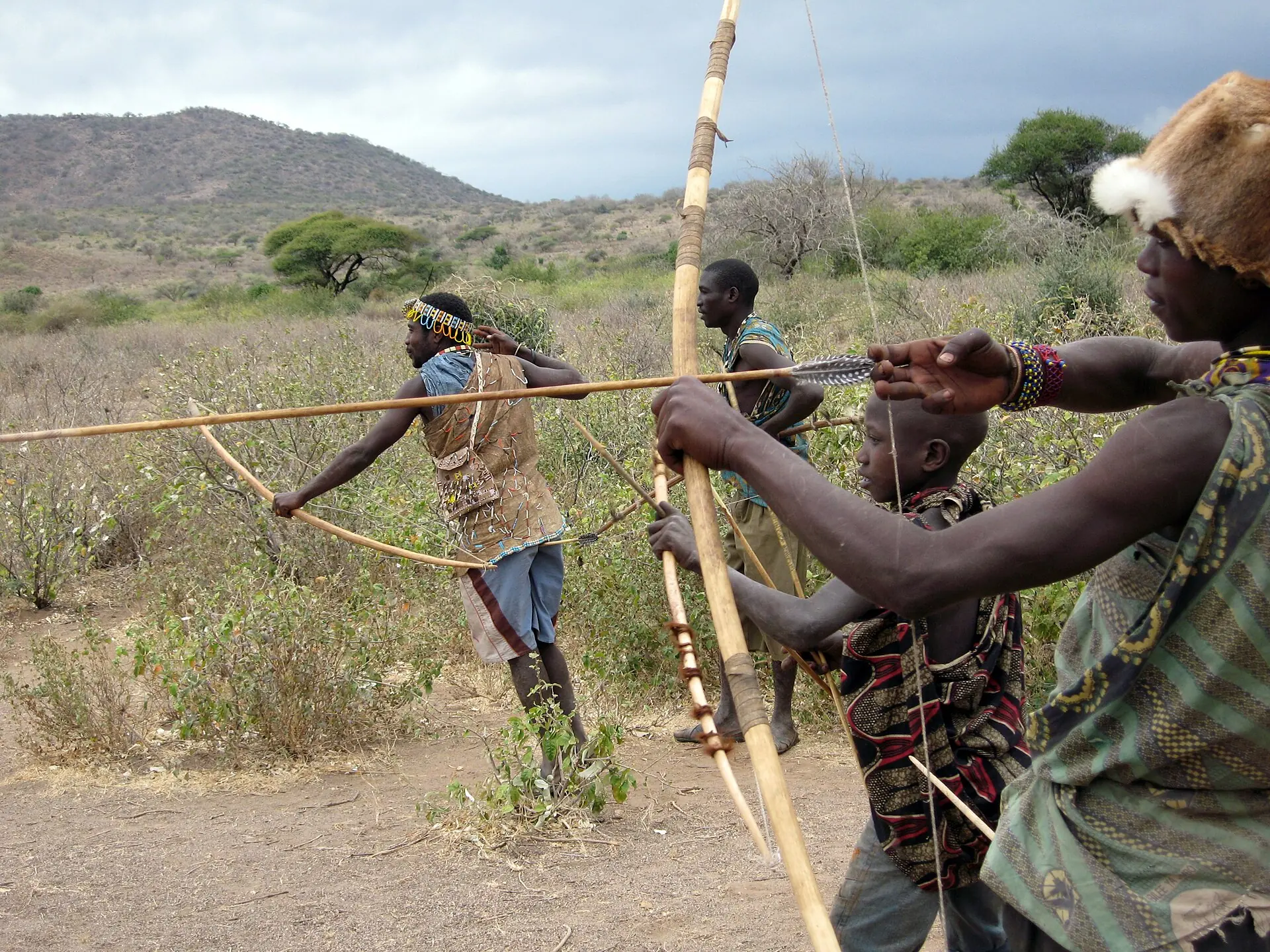
The Hadzabe are among the last people in Africa who still live mainly by hunting and gathering, in the dry bush around Lake Eyasi. A visit means walking with them for a morning: quietly, on their terms, and with a guide who works with the community.
Can you visit the Hadzabe?
Yes, at Lake Eyasi, on foot at dawn.
A visit is a half-day walk with a small Hadza camp, best joined before sunrise when the men go out to hunt, and easy to fit between Ngorongoro and the Serengeti.
Walk with the huntersPeople of the Eyasi basin
The Hadza, or Hadzabe, have lived in the country around Lake Eyasi for a very long time, long before farming and herding reached it.
There are roughly 1,000 to 1,500 Hadza. Only a few hundred still live mainly from the bush; many others live in camps near villages and mix foraging with other work.
Hadzane uses click sounds and is related to no other living language. Most Hadza also speak Swahili, so your guide can translate.
Small camps of a few dozen people move with the seasons. Men hunt with bows; women gather tubers, berries and baobab fruit; honey is a favourite food.
A morning on foot
Every camp and every morning is different. This is the usual shape of a visit.
You leave your lodge in the dark, around six, and drive to the camp with a local guide who speaks Hadzane or Swahili, so you arrive while the men are getting ready.
You follow the hunters through the bush for two or three hours, fast and quietly. Most mornings end with birds or small game, or nothing; the walk itself is the point.
The men make their own bows and arrows, some tipped with poison from the desert rose. Back at camp they may show you how to shoot, and let you try.
A small bird, the greater honeyguide, leads Hadza men to wild bees' nests in answer to their whistle, and they leave it some of the wax. If you are lucky, you will see it happen.
Back at the camp there is time to sit by the fire, which the men can light with a drill stick, while the women come back from gathering tubers and berries.
Many visits continue to their Datoga neighbours, herders whose smiths work scrap metal into knives, jewellery and the arrowheads the Hadza use.
Guests, not an audience
The Hadza have lost most of their land in living memory, and some camps near the road now see visitors every day. How you visit makes a difference.
Good to know
Lake Eyasi is a shallow soda lake on the floor of the Rift Valley, south-west of the Ngorongoro highlands. It shrinks to a crust in dry years and draws flamingos and pelicans when it fills.
About 4 to 4½ hours
Paved road from Arusha to Karatu, then about 50 km of dirt road to Mang'ola: an hour or two from Karatu and the Ngorongoro area.
June to October
The dry months make the tracks easiest; January and February are good too. In the rains, roughly March to May and November, the roads are harder going.
Two nights is ideal
Small lodges and tented camps near the lake and Mang'ola let you be at a camp before sunrise. A day trip from Karatu is possible, but means a very early start.
Northern circuit
Usually between Ngorongoro and the Serengeti, or after Tarangire and Lake Manyara. Wear closed shoes and long trousers against thorns, and bring water and a hat.
Ready-made
 Premium Luxury 8days
Arusha → Tarangire, Lake Manyara, Serengeti, Ngorongoro & Lake Eyasi 8 Days Ultimate Five Parks Safari
The complete Northern Circuit - Tarangire, Lake Manyara, Serengeti, Ngorongoro and Lake Eyasi - in one grand eight-day journey.
From$4,250per person
View itinerary
 Budget 7days
Kilimanjaro International Airport → Longido Maasai Village, Lake Eyasi & Base of Mount Kilimanjaro → Arusha 7 Days Cultural Tour – Longido Maasai, Lake Eyasi & Hadzabe
A 7-day cultural tour of Northern Tanzania focused on its communities - the Longido Maasai, the Hadzabe and Datoga of Lake Eyasi, and the Chagga at the foot of Kilimanjaro - a cultural immersion rather than a wildlife safari.
From$1,955per person
View itinerary
 Budget 5days
Arusha → Tarangire, Serengeti, Ngorongoro Crater & Lake Eyasi 5 Days Camping Safari – Serengeti, Ngorongoro & Lake Eyasi (Hadzabe Experience)
A 5-day budget camping safari through Tarangire, the Ngorongoro Crater, and the Serengeti, finishing with a respectful cultural experience among the Hadzabe community at Lake Eyasi, in a private 4x4 with a professional driver-guide.
From$1,055per person
View itinerary
Quick answers
Around Lake Eyasi in northern Tanzania, in Karatu and Mbulu districts, including the Yaeda Valley. Visits usually start from Mang'ola, north of the lake.
About half a day: an early start, two or three hours on foot with the hunters, then time at the camp. Add the Datoga forge and it fills most of a day.
Older children who are happy to walk fast through thorny bush usually enjoy it. Tell us their ages and we will judge the walk with the guide.
It can be, if the visit is small, unhurried and paid to the camp itself, and if photographs are taken only with permission. Some camps near the road are visited too often; a good guide rotates between camps and keeps the visit on the Hadza's terms.
Yes. Lake Eyasi is about one to two hours from Karatu, so it fits neatly before or after the crater on a northern safari.
A morning with the Hadzabe
Tell us your dates and we will fit a Hadzabe and Datoga visit into your northern safari, with time to do it properly.